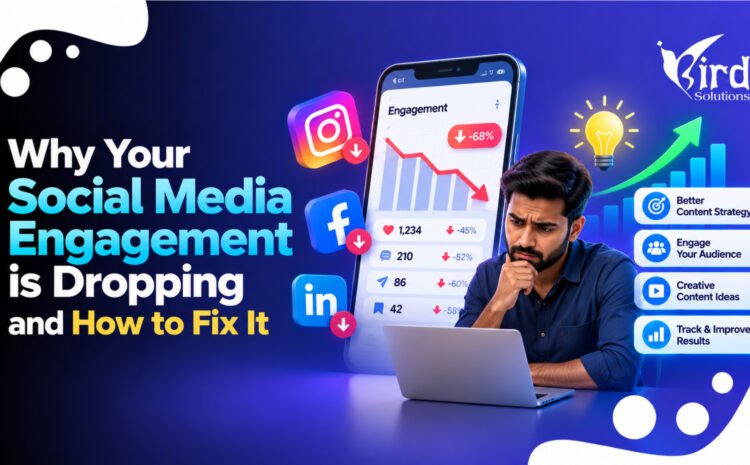
Why Your Social Media Engagement Is Dropping and How to Fix It
You publish regularly, design attractive creatives and share updates about your services – but likes, comments, shares or saves keep falling. It can be tempting to blame the algorithm and immediately change your posting time or add more hashtags.
Before changing everything, identify what has actually declined. Lower reach, fewer interactions per person reached, and fewer website clicks are different problems. Each needs a different response.
For businesses using social media to build awareness and generate enquiries, the goal is not simply to collect likes. It is to publish content that the right audience finds useful, earns meaningful interaction and helps people take the next step.
What Does Social Media Engagement Mean?
Social media engagement refers to the actions people take in response to your content. Depending on the platform and format, these actions may include likes or reactions, comments, shares, saves, replies, video watch time, profile visits, link clicks and direct messages.
Not every interaction has equal value. A save on an educational Instagram carousel, a thoughtful LinkedIn comment, a message asking about a service and a website enquiry can each indicate a different level of interest.
Use a consistent engagement-rate formula when comparing posts. For example, engagement rate by reach can be calculated as:
Engagement rate by reach = Total engagements / Reach x 100
Platforms define and report metrics differently, so compare like with like: the same platform, the same time period, the same denominator and, where possible, similar content formats.
First, Find Out What Has Actually Dropped
Review the last 30-90 days and compare them with an earlier period of similar length. Then diagnose the pattern:
- Reach and impressions are down, but engagement rate is stable: distribution may be the main issue.
- Reach is stable, but interactions per reach are down: the content may be less relevant, compelling or useful.
- Likes are steady, but saves, shares, clicks or enquiries are down: the content may attract light reactions without moving people toward action.
- One format has declined while others remain steady: investigate that format before changing the entire strategy.
- All platforms declined at once: check publishing consistency, audience changes, campaign changes and the quality of the content plan.
This comparison will not reveal every cause, but it helps turn a vague concern into a testable problem.
Why Your Social Media Engagement May Be Dropping
1. Your Content Is Too Promotional
If most posts say “Contact us,” “Buy now,” or “Our services are the best,” followers quickly learn that the feed offers little value unless they are ready to purchase. Most audiences need education, proof and useful ideas before they are ready to enquire.
Try a more balanced mix:
- Educational posts that answer a real customer question.
- Proof-based content such as project examples, demonstrations, testimonials or behind-the-scenes process.
- Opinion or expertise posts that explain what you have learned.
- Service posts that clearly show who the offer is for and what problem it solves.
For example, instead of only promoting social media management, publish “Three reasons your business posts get views but no enquiries,” then explain the fixes and link to a relevant service page.
2. Your Posts Look Similar Every Week
Repeating the same template, caption structure and message can make content easier to produce – but also easier to ignore. A consistent brand style is useful; repeating the same idea is not.
Keep the visual identity, but vary the substance. Use short videos for demonstrations, carousels for step-by-step explanations, single-image posts for one clear point, polls or questions when appropriate, and case studies when you have real evidence to share.
3. The Opening Does Not Give People a Reason to Stop
On a busy feed, a post needs to communicate quickly why it matters. A vague opening such as “We are happy to announce…” may be less compelling than a clear problem, useful question, strong result or specific observation.
Examples of stronger openings:
- “Your social media reach is down. Check these three metrics before changing your strategy.”
- “A website visitor viewed your service page but did not enquire. Here are three possible reasons.”
- “Before you copy a competitor’s Reel, ask whether it answers your audience’s question.”
Use a strong hook without exaggerating. The post should deliver what its opening promises.
4. You Are Reposting Content Without Adding Enough Original Value
Reposting other people’s videos or making only minor edits may not give audiences a reason to follow your brand. Meta’s March 2026 guidance says Facebook is prioritizing original content and reducing distribution for duplicative or minimally edited material. Adding genuine analysis, new information or a meaningful creative contribution is a better approach.
Use trends as a starting point – not as a substitute for your expertise. Explain what a trend means for your industry, demonstrate a process, share a case-specific lesson or create an original example.
5. You Are Optimizing for the Wrong Audience
A post can receive many reactions and still attract people who will never become customers. Broad entertainment content may be suitable for some brands, but a B2B company, local service provider and consumer brand do not necessarily need the same audience or content strategy.
Review which posts attract the right people: relevant job roles, locations, industries, customer questions, profile visits, qualified clicks and enquiries. Build content around the people you actually serve, not just the biggest possible audience.
6. You Expect Every Platform to Behave the Same Way
A caption that works on Instagram may need a different structure on LinkedIn. A LinkedIn audience may respond to practical expertise and professional discussion, while Instagram or Facebook may call for more visual demonstrations, short-form video, community content or local proof.
LinkedIn explained in March 2026 that its Feed systems are being improved to better understand post topics and members’ evolving interests. The company also said it is working to reduce automated comments, engagement pods and generic engagement bait. Prioritize relevant professional insight and genuine discussion rather than artificial activity.
Repurpose the idea, not necessarily the exact post. Adapt the opening, format, length, visual and call to action to each platform.
7. You Publish but Do Not Participate
Social media is a two-way channel. When people ask a real question or add a thoughtful comment, a relevant reply can continue the conversation and help the business understand what its audience cares about.
Set aside time to respond to comments and direct messages, answer questions clearly, and join relevant conversations. Do not use automated or copied comments simply to create the appearance of engagement.
8. Your Posting Schedule Is Inconsistent – or the Volume Is Unsustainable
Posting every day is not automatically better than posting three useful times a week. The best schedule is one your team can sustain while maintaining relevance and quality.
Check when your own audience is active and test different publishing windows over several weeks. Treat timing as an experiment, not a universal rule.
How to Fix Falling Social Media Engagement
Step 1: Audit Your Best and Worst Posts
Select the 10 strongest and 10 weakest posts from the period you are reviewing. Compare topic, format, opening line, creative, length, audience, reach, engagement rate, saves, shares, clicks and enquiries. Look for repeatable differences rather than drawing conclusions from one post.
Step 2: Give Every Post One Clear Purpose
Decide whether a post is meant to create awareness, teach something, start a relevant conversation, build trust, drive a website visit or generate an enquiry. A single post can contribute to several goals, but it should have one primary objective.
Step 3: Make the Content More Useful and Specific
- Replace generic tips with examples from your sector.
- Use original images, demonstrations, observations and case-specific lessons where available.
- Answer one customer question per post instead of squeezing several unrelated ideas into one creative.
- Make captions and on-screen text clear enough for a viewer to understand the topic quickly.
- Use calls to action that fit the content – save a checklist, share a useful resource, ask a relevant question or visit a service page.
Step 4: Use Platform-Specific Guidance
Instagram provides a Best Practices section in the Professional Dashboard covering creation, engagement, reach and guidelines, with account-specific tips. Review those recommendations alongside your own insights rather than relying only on generalized advice.
For Facebook, prioritize original content and add meaningful context when using remixes or third-party material. For LinkedIn, share informed professional perspectives, explain the reasoning behind your recommendations and invite genuine discussion – not empty agreement.
Step 5: Build a Repeatable Content System
For many businesses, a practical weekly mix could include:
- One educational post answering a common customer question.
- One original short video or demonstration.
- One proof-based post, case study or behind-the-scenes update.
- One discussion or community-focused post when relevant.
This is a starting point, not a mandatory posting quota. Adjust the mix to the platform, audience, resources and business goals.
Step 6: Connect Engagement to Business Outcomes
A post with fewer likes may still be valuable if it reaches the right decision-makers, generates saves, drives qualified website visits or starts sales conversations. Track meaningful actions alongside visible engagement.
- Awareness: reach, impressions, video views and relevant audience growth.
- Content value: saves, shares, watch time and substantive comments.
- Consideration: profile visits, website clicks, service-page visits and direct messages.
- Business outcomes: qualified enquiries, bookings, leads and sales where tracking is available.
Frequently Asked Questions
Why is my social media engagement suddenly dropping?
Possible reasons include reduced reach, a change in audience interest, repetitive content, weaker openings, platform-specific distribution changes or inconsistent posting. Compare reach and engagement rate separately before choosing a fix.
Does low engagement mean the algorithm is hiding my posts?
Not necessarily. Distribution systems are personalized and change over time, but low engagement can also come from content relevance, audience fit, format or creative quality. Check platform account-status and recommendation guidance where available, then review your data.
How long does it take to improve social media engagement?
There is no guaranteed timeline. Use a 30-day test period to establish a baseline and test improvements, but allow for differences in posting frequency, audience size, seasonality and platform.
Should I use trending audio and hashtags to increase engagement?
Use them when they fit your audience and content. They are not a substitute for relevance, originality or a clear message. Review each platform’s current creator guidance and your own analytics.
Are engagement pods or automated comments a good solution?
No. Artificial engagement does not demonstrate genuine interest and may conflict with platform policies or distribution goals. Focus on relevant content and real conversations instead.
Which social media engagement metrics matter most?
It depends on the goal. Saves and shares can help assess content value, comments can indicate discussion, clicks can show interest, and qualified enquiries or sales connect social media to business outcomes.
Can a social media agency help recover engagement?
A capable agency can audit performance, improve content planning and creative, adapt posts to each platform, manage community responses and report on meaningful metrics. Results depend on audience, offer, content, consistency and the wider market.
Conclusion
Falling engagement is a signal to investigate – not a reason to post more content blindly. Separate reach from response, examine what your strongest posts have in common, publish original and audience-relevant material, adapt content to each platform, and make time for genuine conversations.
For businesses, successful Social Media Marketing is not about chasing likes at any cost. It is about building trust, helping the right people, and making it easy for interested audiences to take the next step.
Need Help Improving Your Social Media Performance?
iBird Solutions provides Social Media Services and Digital Marketing Services for businesses looking to improve content strategy, audience engagement and online visibility. A structured review of your content, analytics and conversion path can help identify practical next steps.

Write a Comment