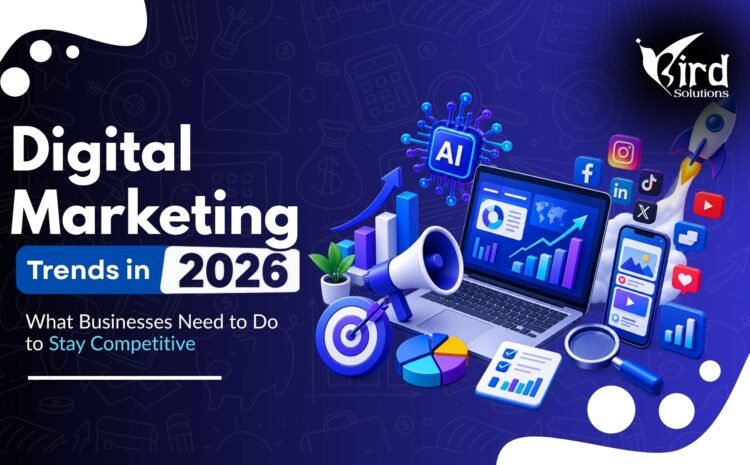
Digital Marketing Trends in 2026: What Businesses Need to Do to Stay Competitive
Digital marketing is no longer just about ranking on Google, posting on social media or running paid advertisements.
In 2026, customers can discover a business through Google Search, AI-powered search experiences, social platforms, videos, reviews, websites and conversational tools. That makes digital marketing less about managing isolated channels and more about creating a connected customer journey.
AI is accelerating this change. Recent 2026 marketing research highlights AI-assisted personalization, automation, adapting SEO to search changes, and repurposing content across channels among major marketing priorities. Core channels such as websites, blogs, SEO and social media. Remain important, but the way businesses use them is changing.
1. AI Is Changing How Customers Search
Traditional search often starts with a short keyword such as “digital marketing agency Ahmedabad.”
AI-powered search can involve much more conversational questions, such as “Which digital marketing agency in Ahmedabad can help a manufacturing company generate B2B leads?”
This matters because businesses need content that answers real customer questions, demonstrates expertise and provides useful context rather than simply repeating keywords.
AI SEO, Answer Engine Optimization (AEO) and Generative Engine Optimization (GEO). Are therefore becoming useful ways to think about visibility, across modern search experiences. Google’s current guidance states that its foundational SEO practices.Remain relevant for generative AI features such as AI Overviews and AI Mode.
What Businesses Should Do
- Answer specific customer questions clearly.
- Create original, experience-led information rather than generic summaries.
- Use descriptive headings, FAQs and logical page structures.
- Build topical authority around the problems your business solves.
- Support important claims with trustworthy sources where appropriate.
- Make important content crawlable, indexable and easy to understand.
2. SEO Is Evolving Into AI SEO
SEO is not disappearing. It is expanding.
A strong modern search strategy considers traditional search engines as well as AI-generated answers and conversational discovery.
Google’s official guidance emphasizes that generative AI search still relies on core Search systems, crawlability, indexing, helpful content, page experience and other established SEO fundamentals.
A practical AI SEO framework can include:
- Technical SEO
- Content optimization
- Entity and brand optimization
- Answer-focused content
- Local SEO
- Internal linking
- Structured data where appropriate
- Digital PR and credible brand mentions
- Ongoing measurement in Search Console and analytics
3. Personalization Is Becoming a Competitive Advantage
Customers increasingly expect businesses to understand their specific needs. A single generic message may not work equally well for every audience.
For example, a company selling accounting software could create different content for startups, manufacturing companies, retailers, professional services firms and larger enterprises.
AI can help marketers scale research, segmentation and content production, but personalization should still be based on real customer needs and useful information—not mass-producing generic pages.
4. Social Media Is Becoming a Discovery Channel
Social media is no longer only about followers and likes. People use social platforms to discover businesses, products, services, experts, reviews, tutorials and recommendations.
That makes Social SEO increasingly relevant. A social post should be understandable and discoverable even when someone encounters it without already following the brand.
Current 2026 social media research points toward interest-based discovery, social search, short-form video, community building and social commerce as important areas for marketers.
Example
Instead of posting “Contact us for digital marketing services,” a business could publish “5 reasons your website gets traffic but doesn’t generate leads.” The second topic directly addresses a customer problem and creates a natural opening for a service conversation.
5. Short-Form Video Continues to Matter
Video can demonstrate expertise quickly and can be adapted to different stages of the customer journey.
One strong topic can become a blog article, LinkedIn post, Instagram Reel, YouTube Short, infographic, FAQ and email section.
The goal is not to publish more content simply for volume. The goal is to extract more value from useful ideas and distribute them in formats customers already consume.
6. Your Website Is Still Your Digital Foundation
AI and social media may influence how people discover a company, but the website remains the central place where prospects can understand the business, evaluate services and take action.
A strong business website should clearly communicate who the company helps, what it offers, why customers should trust it, what makes it different and how visitors can contact the business.
Website performance also matters. Google’s current AI-search guidance recommends foundational technical practices such as crawlability, indexability, page experience, useful textual content, internal linking and accessible site structure.
7. Data Matters More Than Vanity Metrics
Businesses should look beyond likes, followers and impressions. More useful questions include:
How many qualified leads came from organic search?
- Which landing pages generate enquiries?
- Which campaigns generate sales?
- Which keywords attract high-intent visitors?
- Which content assists conversions?
- What is the cost per qualified lead?
- Which channels produce the best customers?
8. Businesses Need an Integrated Digital Marketing Strategy
The biggest mistake is treating every channel as a separate activity.
SEO should support content. Content should support social media. Social media should support awareness and demand generation. The website should convert that demand into enquiries. Paid advertising can accelerate the process when the economics make sense.
A simple integrated model is:
Search → Content → Social → Website → Lead → Sales
What Should Businesses Prioritize in 2026?
1. Build a strong website foundation
Make the website fast, technically sound, mobile-friendly, easy to navigate and clear about its value proposition.
2. Develop an AI SEO strategy
Optimize important pages for traditional search and AI-powered discovery while keeping people-first content at the center.
3. Create useful content
Answer the questions customers ask before they buy and demonstrate practical expertise.
4. Build social visibility
Focus on useful posts, videos, expertise, community and social discovery—not only promotional messages.
5. Measure leads and revenue
Connect marketing activity with qualified enquiries, sales and customer value.
Conclusion
Digital marketing in 2026 is becoming less about individual tactics and more about how different channels work together.
Businesses need to be discoverable when customers search, useful when customers have questions, visible when customers browse social platforms and credible when customers are ready to make a decision.
The businesses that adapt early will not necessarily be the ones producing the most content. They will be the ones producing the most useful, relevant and trustworthy digital experiences.
Ready to Improve Your Digital Visibility?
iBird Solutions helps businesses build practical digital marketing strategies covering AI SEO, digital marketing, social media marketing and website development in Ahmedabad.
If your website is generating traffic but not enough enquiries—or your business is not getting enough visibility online—review your digital strategy and identify the highest-impact opportunities first.
Frequently Asked Questions (FAQs)
Is digital marketing still effective in 2026?
Yes. The channels are evolving, but search, websites, content, social media, email and paid advertising remain important parts of the marketing ecosystem.
Is SEO dead because of AI?
No. SEO is evolving. Businesses increasingly need strong traditional SEO foundations while also making information useful and understandable in AI-powered search experiences.
What is AI SEO?
AI SEO is a practical approach to improving visibility across modern search experiences by combining traditional SEO fundamentals with content and brand strategies designed for AI-assisted discovery.
Should small businesses invest in digital marketing?
Yes, when the strategy matches the business model and resources. A small business may benefit more from focused local SEO, content, social media and conversion optimization than from trying to use every available channel.
What is the most important digital marketing trend in 2026?
There is no single trend that applies equally to every business. AI-powered search, personalization, social discovery, useful content and measurable customer acquisition are major developments worth evaluating.