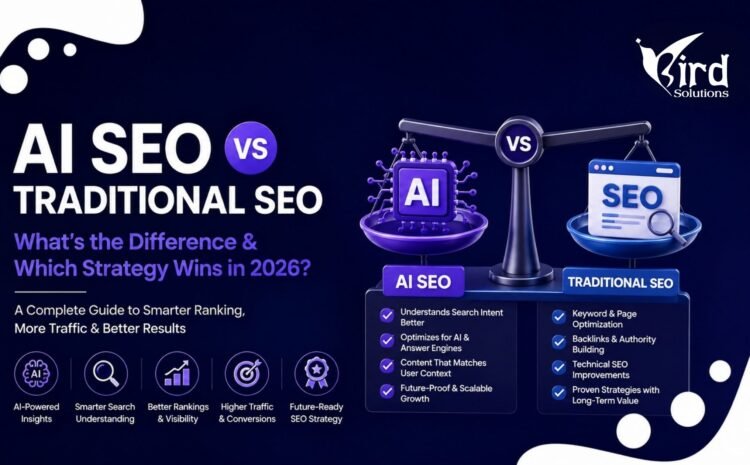
AI SEO vs Traditional SEO: What’s the Difference and Which Strategy Does Your Business Need?
Search is changing, but the fundamentals of being discoverable online have not suddenly disappeared.
For years, businesses have invested in traditional SEO to improve their visibility in search results. Today, customers can also encounter AI-generated answers, conversational search experiences and follow-up questions that may provide links to websites.
That creates an important question for business owners: should you continue with SEO, move to AI SEO, or use both?
The practical answer is simple: businesses need strong SEO foundations plus a broader strategy for how their information is discovered, understood and surfaced in modern AI-powered search experiences.
What Is Traditional SEO?
Search Engine Optimization (SEO) is the practice of improving a website so search engines can crawl, understand and rank its pages for relevant queries.
Traditional SEO commonly includes:
- Keyword and search-intent research
- Technical SEO
- On-page optimization
- Content creation
- Internal linking
- Local SEO
- Structured data
- Page experience and performance
- Digital PR and authority building
- Search Console and analytics measurement
What Is AI SEO?
AI SEO is a practical term for adapting search strategy to AI-powered discovery. It includes the same strong SEO foundations while paying additional attention to how clearly a business’s information can be understood, answered, summarized and referenced in AI-assisted search experiences.
Google’s current guidance is particularly important here: Google says its generative AI search features are built on core Search ranking and quality systems, and that SEO best practices continue to be relevant. Google also advises focusing on unique, useful, people-first content rather than chasing special AI hacks.
SEO vs AI SEO: The Practical Difference
| Area | Traditional SEO | AI SEO |
|---|---|---|
| Primary focus | Visibility in search results | Visibility across search and AI-assisted discovery |
| Queries | Keywords and search intent | Keywords plus conversational, complex and follow-up questions |
| Content | Relevant, useful and optimized pages | Useful pages that are also clear, contextual and easy to synthesize |
| Technical foundation | Crawlability, indexing, speed, structure | The same fundamentals remain essential |
| Authority | Links, reputation, topical relevance | Brand/entity context, reputation, mentions and trustworthy sources matter |
| Local visibility | Maps and local search | Local context plus clear business/service information |
| Measurement | Rankings, impressions, clicks, conversions | Those metrics plus visibility/citation observations and assisted conversions |
SEO Is Not Being Replaced by AI SEO
One of the biggest misconceptions is that businesses must abandon SEO and start a completely separate AI optimization program.
Google’s May 2026 guidance makes the relationship clear: optimizing for generative AI search is still fundamentally optimizing the search experience, and established SEO best practices remain important.
That means a technically weak website with thin or generic content does not become strong simply because someone adds an ‘AI SEO’ label to the service.
What Are AEO and GEO?
AEO — Answer Engine Optimization
AEO is commonly used to describe content practices aimed at making information easy to extract and present as an answer. It can include direct answers, FAQs, clear definitions, structured content and question-led pages.
GEO — Generative Engine Optimization
GEO is commonly used to describe efforts to improve how a brand or website is represented in generative AI answers.
These terms can be useful for describing different goals, but businesses should not treat them as magic ranking systems. The strongest foundation remains useful content, sound technical SEO, clear information architecture and genuine authority.
How AI-Powered Search Changes Customer Behavior
- A customer may begin with a broad question rather than a keyword.
- They may ask follow-up questions without returning to a traditional results page.
- They may compare several providers in one conversational session.
- They may ask for recommendations based on location, budget, industry or specific requirements.
- They may encounter a business through an AI-generated summary and then visit the company’s website to verify details.
Example: A B2B Company
A manufacturing company might search for ‘digital marketing agency Ahmedabad.’ A more detailed AI-search journey could be: ‘Which digital marketing agency in Ahmedabad understands B2B manufacturing and can provide SEO, content and LinkedIn marketing?’
A strong website should therefore explain not only that the company provides digital marketing, but also who it serves, what services it provides, how its process works and which business problems it addresses.
What Businesses Should Optimize for AI Search
1. Build Strong Technical SEO Foundations
- Make important pages crawlable and indexable.
- Use a logical website structure.
- Maintain useful internal links.
- Keep important content accessible in HTML.
- Improve mobile usability and performance.
- Fix broken pages and unnecessary technical barriers.
2. Answer Real Customer Questions
Instead of creating articles only around keyword variations, build content around the decisions customers need to make.
- What does the service include?
- Who is it suitable for?
- How does the process work?
- How long does implementation typically take?
- What affects cost?
- What should a customer prepare before starting?
- How should success be measured?
3. Make Business Information Explicit
Clearly state your company name, location, services, industries served, contact information, expertise and other important business facts. Consistent information helps users—and systems that interpret web content—understand the business.
4. Demonstrate First-Hand Expertise
Generic AI-generated articles are easy to produce. Useful business knowledge is harder to replicate.
- Original case studies
- Practical examples
- Expert commentary
- Process explanations
- Screenshots or demonstrations where appropriate
- Original research or observations
- Clear author and company information
5. Build Topic Clusters
A business should cover its core subject comprehensively rather than publishing dozens of disconnected keyword pages.
For iBird Solutions, for example, a digital marketing pillar can connect to AI SEO, AEO/GEO, social media marketing, local SEO, website development and WordPress development.
6. Strengthen Local Relevance
For businesses targeting Ahmedabad, local context should be clear. Location pages and service pages should explain the services, industries, customer problems and local market context they genuinely serve.
For example, iBird Solutions can build content around digital marketing services in Ahmedabad, AI SEO services in Ahmedabad, social media marketing for Ahmedabad businesses and WordPress development in Ahmedabad—provided each page offers genuinely different value.
A Practical AI SEO Framework for Businesses
Step 1: Understand the audience
Identify customer segments, buying stages, questions, objections and high-value problems.
Step 2: Map search intent
Map informational, commercial, local and transactional queries to the right pages.
Step 3: Fix technical foundations
Improve crawlability, indexing, site architecture, internal linking and performance.
Step 4: Build useful content
Create original pages that answer questions and demonstrate expertise.
Step 5: Strengthen entities and brand context
Keep company, service, location and expertise information consistent across important sources.
Step 6: Optimize for answers
Use clear definitions, direct answers, FAQs, lists and structured explanations where they genuinely improve usability.
Step 7: Build authority
Earn relevant mentions, links, reviews, references and other legitimate reputation signals.
Step 8: Measure outcomes
Track organic performance, qualified leads, conversions and emerging AI-search visibility signals.
Common AI SEO Mistakes to Avoid
- Publishing large volumes of low-value AI-generated content.
- Creating pages only to target slight variations of the same keyword.
- Assuming an AI-specific file or markup automatically creates visibility.
- Removing traditional technical SEO because the business is focused on AI.
- Making unsupported claims about being ‘guaranteed’ to appear in ChatGPT or AI Overviews.
- Measuring success only by AI citations without checking qualified traffic and leads.
How Should You Measure AI SEO?
AI-search measurement is still developing, so use multiple signals rather than one score.
- Organic impressions and clicks
- Search rankings for strategic topics
- Qualified organic leads
- Conversion rate from organic traffic
- Brand-search growth
- Visibility in relevant AI-search experiences where observable
- Referral traffic from AI platforms where analytics can identify it
- Mentions and citations in relevant third-party sources
Does Your Business Need AI SEO Services?
AI SEO can be particularly useful when your business depends on online discovery, has complex services, serves multiple customer segments, operates in competitive search markets or wants to strengthen visibility beyond traditional keyword rankings.
However, the first step should be an audit. If technical SEO, website structure, content quality and conversion fundamentals are weak, those issues should be addressed before chasing advanced visibility tactics.
Conclusion
AI search does not mean businesses should abandon SEO. It means search visibility now needs to be considered across a wider set of discovery experiences.
The strongest strategy combines technical SEO, useful content, clear business information, topical authority, local relevance, trustworthy brand signals and measurement.
For iBird Solutions, this creates an opportunity to help businesses move from a narrow ‘rank for keywords’ approach toward a broader digital visibility strategy covering SEO, AI SEO, AEO, GEO, social media and website performance.
Ready to Build an AI-Ready Search Strategy?
iBird Solutions provides digital marketing, AI SEO, social media and website development services in Ahmedabad. If your business wants stronger visibility in traditional search and emerging AI-powered discovery, start with a practical assessment of your website, content and search strategy.
Frequently Asked Questions (FAQs)
Is traditional SEO still important in 2026?
Yes. Google states that SEO fundamentals continue to matter for its generative AI search features. Technical accessibility, useful content and strong search fundamentals remain important.
What is the difference between SEO and AI SEO?
Traditional SEO focuses on improving visibility in search engines. AI SEO extends that strategy to modern AI-assisted discovery by emphasizing conversational questions, clear context, entities, useful answers and broader brand visibility while retaining SEO fundamentals.
Can AI SEO guarantee a business will appear in ChatGPT or Google AI Overviews?
No responsible agency should guarantee a specific AI citation or placement. AI responses vary by query, system, location, freshness and other factors.
Should I hire an AI SEO agency in Ahmedabad?
If your business relies on search-driven leads and you want a strategy covering traditional SEO plus AI-search readiness, an experienced AI SEO agency in Ahmedabad can help. Evaluate the agency based on its process, technical expertise, content quality, measurement approach and business understanding—not the label alone.
Is AI-generated content good for SEO?
AI can assist research, drafting and content workflows, but publishing large amounts of generic or low-value content is not a substitute for originality, usefulness and expertise. Human review and genuine value remain important.
What should I do first for AI SEO?
Start with a technical and content audit, identify high-value customer questions, improve important service pages, strengthen internal linking and build useful topic clusters before expanding into more advanced optimization.