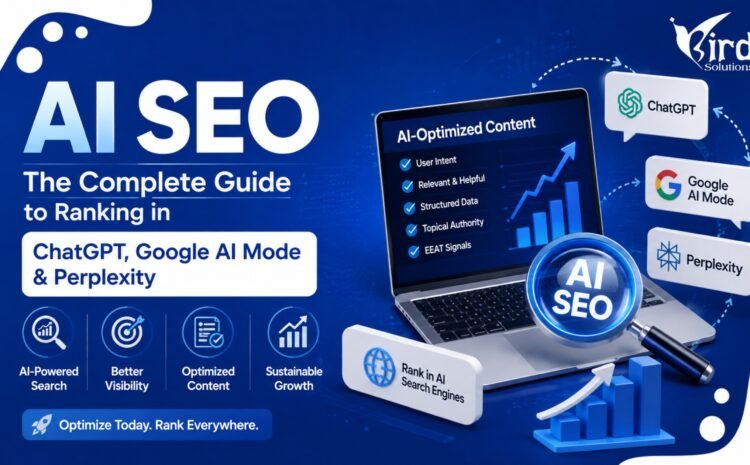
AI SEO : The Complete Guide to Ranking in ChatGPT, Google AI Mode & Perplexity
Artificial Intelligence is changing the way people search for information online. Instead of clicking through multiple websites, users now ask questions directly to AI-powered search tools like ChatGPT, Google AI Mode, Gemini, Claude, and Perplexity. These platforms generate answers instantly, making traditional SEO alone no longer enough.
To stay visible in this new search landscape, businesses need AI SEO Services, a modern approach that combines traditional SEO with Answer Engine Optimization (AEO) and Generative Engine Optimization (GEO).
In this guide, you’ll learn what AI SEO is, why it matters, and how to optimize your website for the future of AI-powered search.
What is AI SEO?
AI SEO is the process of optimizing your website so that both traditional search engines and AI-powered search assistants can easily understand, trust, and recommend your content.
Unlike conventional SEO, which focuses mainly on ranking webpages, AI SEO aims to make your content the preferred source for AI-generated answers.
An effective AI SEO strategy helps your business appear in:
- ChatGPT responses
- Google AI Mode
- Google AI Overviews
- Microsoft Copilot
- Gemini
- Claude
- Perplexity AI
Traditional SEO vs AI SEO
| Targets search engine rankings | Targets AI-generated answers and search results |
| Focuses on keywords | Focuses on user intent and semantic relevance |
| Optimizes webpages | Optimizes knowledge, entities, and structured content |
| Relies heavily on backlinks | Prioritizes authority, expertise, and trusted information |
| Optimized for Google | Optimized for Google and AI platforms |
Traditional SEO remains essential, but AI SEO builds on it by helping AI systems confidently reference your content.
Why AI SEO Matters in 2026
Search behavior has shifted significantly. Users increasingly expect direct answers instead of browsing multiple websites. AI assistants summarize information from trusted sources, reducing the number of clicks to traditional search results.
Businesses that adopt AI SEO can:
- Increase visibility across AI-powered platforms
- Build stronger brand authority
- Attract highly qualified traffic
- Improve lead generation
- Stay competitive as search evolves
Companies that delay adapting risk losing visibility as AI-assisted search becomes more common.
The Three Pillars of AI SEO
1. Answer Engine Optimization (AEO)
Answer Engine Optimization focuses on creating content that directly answers user questions.
Examples include:
- FAQs
- Step-by-step guides
- Definitions
- Comparisons
- Lists
- Clear explanations
AI systems favor concise, well-structured answers because they can easily incorporate them into generated responses.
2. Generative Engine Optimization (GEO)
Generative Engine Optimization ensures your content is understandable and trustworthy for large language models.
Best practices include:
- Writing comprehensive, topic-focused content
- Using clear headings and logical structure
- Providing original insights and expertise
- Covering related subtopics naturally
- Maintaining factual accuracy
3. Traditional SEO
Core SEO fundamentals still matter, including:
- Fast page speed
- Mobile-friendly design
- Internal linking
- Optimized title tags and meta descriptions
- High-quality backlinks
- Technical SEO
- Schema markup
AI SEO complements—not replaces—traditional SEO.
8 Best Practices for AI SEO
1. Write for Questions, Not Just Keywords: Create content that answers real user questions such as, What is AI SEO? | How does AI SEO work? | Why is AI SEO important? Question-based content aligns well with AI-generated responses.
2. Use Clear Heading Structure: Organize your content with descriptive H2 and H3 headings. This improves readability for both users and AI systems.
3. Add FAQ Sections: Well-written FAQs increase the likelihood of appearing in featured snippets and AI-generated answers.
4. Demonstrate Expertise: Include original examples, case studies, statistics, and practical experience to strengthen credibility.
5. Implement Structured Data: Use schema markup such as, FAQ Schema, Article Schema, Organization Schema, Breadcrumb Schema, Structured data helps search engines interpret your content more effectively.
6. Build Topic Authority: Instead of publishing isolated articles, create comprehensive topic clusters that demonstrate expertise in your niche.
7. Keep Content Updated : AI systems tend to favor accurate and up-to-date information. Regularly refresh older articles to maintain relevance.
8. Improve User Experience: Fast-loading, secure, and mobile-friendly websites provide a better experience and support stronger search performance.
Common AI SEO Mistakes
Avoid these common pitfalls:
- Publishing AI-generated content without human review
- Keyword stuffing
- Ignoring user intent
- Using outdated information
- Failing to optimize for mobile devices
- Neglecting structured data
- Creating thin or duplicate content
Quality, relevance, and trustworthiness remain essential.
The Future of AI Search
AI-powered search is reshaping how people discover information. Businesses that embrace AI SEO today will be better positioned to earn visibility, authority, and customer trust tomorrow.
The goal is no longer just to rank on the first page of search results—it is to become a trusted source that AI platforms choose to reference.
Conclusion
AI SEO combines the strengths of traditional SEO, Answer Engine Optimization, and Generative Engine Optimization to help businesses succeed in the era of AI-powered search.
By creating helpful, authoritative, and well-structured content, your website can improve its visibility across ChatGPT, Google AI Mode, Gemini, Claude, Perplexity, and other AI-driven platforms.
Investing in AI SEO today prepares your business for the future of online search.
Want your business to rank in ChatGPT, Google AI Mode, Gemini, Claude, and Perplexity?
At iBird Solutions, we specialize in AI SEO (AEO + GEO), Technical SEO, Content Optimization, Local SEO, and WordPress Development. Our strategies are designed to improve your visibility across both traditional search engines and emerging AI-powered search platforms.
Contact iBird Solutions today to future-proof your digital presence and stay ahead of the competition.
Frequently Asked Questions (FAQs)
What is AI SEO?
AI SEO is the process of optimizing website content so it can be easily understood, trusted, and recommended by both search engines and AI-powered platforms like ChatGPT and Google AI Mode.
What is the difference between SEO, AEO, and GEO?
SEO improves search engine rankings, AEO focuses on answering user questions directly, and GEO optimizes content for AI models that generate responses.
Does ChatGPT rank websites?
ChatGPT does not rank websites like a search engine, but it can reference and summarize authoritative, well-structured content from trusted sources, depending on how it is integrated with search and browsing capabilities.
Is schema markup important for AI SEO?
Yes. Structured data helps search engines understand your content, improving the chances of enhanced search features and supporting AI interpretation.
Which industries benefit most from AI SEO?
Nearly every industry can benefit, including healthcare, legal services, manufacturing, eCommerce, SaaS, finance, education, and digital marketing.
How long does AI SEO take to show results?
Results vary based on your website’s authority, competition, and content quality. Consistent optimization typically produces measurable improvements over several months.
Want your business to rank in ChatGPT, Google AI Mode, Gemini, Claude, and Perplexity?
At iBird Solutions, we specialize in AI SEO (AEO + GEO), Technical SEO, Content Optimization, Local SEO, and WordPress Development. Our strategies are designed to improve your visibility across both traditional search engines and emerging AI-powered search platforms.
Contact iBird Solutions today to future-proof your digital presence and stay ahead of the competition.