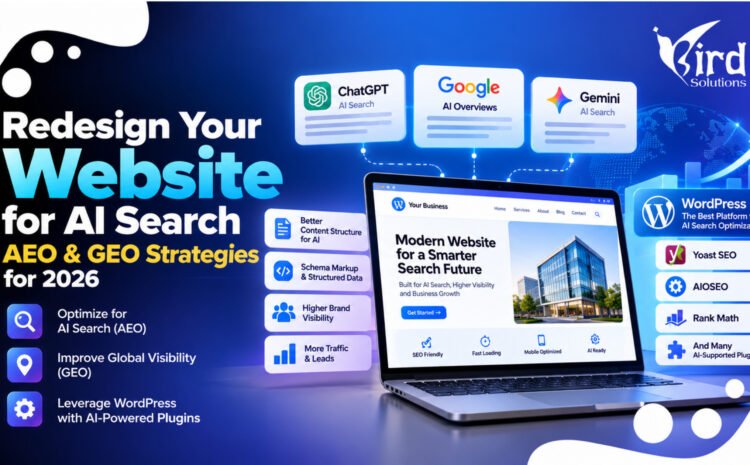
Redesign Your Website for AI Search: AEO & GEO Strategies
Search is changing. Customers still use traditional search engines, but they are also asking longer questions, exploring AI-generated answers and comparing providers through conversational search experiences. If your website has unclear service pages, thin content, weak internal links or technical barriers, it may be harder for both people and search systems to understand what your business does.
That does not mean every company needs to rebuild its website from scratch. Often, the right first step is to audit the existing site, fix technical problems, restructure important pages and publish more useful content. A redesign is worthwhile when the current platform or architecture makes those changes difficult, or when the website no longer supports the business’s goals.
For businesses planning a redesign, Answer Engine Optimization (AEO) and Generative Engine Optimization (GEO) are useful terms for thinking about how content can be understood and surfaced in answer-based and AI-driven discovery. Treat them as an extension of sound SEO not a replacement for technical SEO, clear content and a credible brand.
What Are AEO and GEO?
AEO: Answer Engine Optimization
AEO focuses on making information clear and useful for systems that answer questions. Practical examples include direct explanations, well-structured FAQs, concise definitions, comparison tables, step-by-step instructions and content that responds to a genuine customer question.
GEO: Generative Engine Optimization
GEO is commonly used for work intended to improve a brand’s visibility and representation in generative AI experiences. It may involve building clear brand and service information, publishing distinctive expertise, maintaining technical accessibility and earning legitimate references from relevant sources.
The terminology can help organize a strategy, but businesses should avoid treating AEO or GEO as secret ranking systems. Google’s published guidance says SEO fundamentals remain relevant to AI Overviews and AI Mode, and there are no additional technical requirements or special schema types needed for those features.
Why Your Existing Website May Need a Restructure
A website may be due for strategic restructuring when:
- The homepage tries to explain too many services without clear paths to detail pages.
- Several pages target the same keywords and repeat the same information.
- Important services are buried several clicks deep or receive few internal links.
- Service pages list features but do not answer customer questions about process, suitability, outcomes or costs.
- The website is difficult to crawl, slow, unstable on mobile or accidentally blocked from indexing.
- The design makes key content hard to read or relies heavily on images without useful text.
- The company has evolved, but the website still describes outdated services or expertise.
The solution may be a targeted content and technical overhaul rather than a full redesign. Preserve pages that already perform well and change URLs only when there is a clear reason.
What Google’s AI Search Guidance Actually Means
Google’s guidance for generative AI search emphasizes helpful, reliable, people-first content and established SEO fundamentals. A page needs to meet Google Search technical requirements and be eligible to appear with a snippet to be considered as a supporting link in AI Overviews or AI Mode. Eligibility does not guarantee crawling, indexing, ranking or selection in an answer.
Prioritize these basics:
- Allow crawling of important pages and ensure they can be indexed.
- Make key content available as readable text.
- Use descriptive headings and clear page titles.
- Link important pages from relevant areas of the site.
- Support text with useful images or video where appropriate.
- Ensure structured data matches visible page content.
- Keep business information, local details and contact information accurate.
- Provide a good experience across devices.
Do not redesign around the idea that Google requires a special AEO plugin, an llms.txt file or unique AI schema to appear in AI Overviews. Google states that those additional requirements are not needed for these features. Other tools may help with workflows or documentation, but they are not guaranteed AI-ranking switches.
How to Restructure Your Website for AEO and GEO
1. Build a Clear Service Architecture
Each main service should have a dedicated, useful page that explains the service, its audience, the problem it solves, the process, deliverables, relevant proof and next steps. Supporting blog articles should answer narrower questions and link naturally back to the appropriate service page.
For iBird Solutions, a practical structure could look like:
- Digital Marketing Services → strategy, channels, measurement and service details
- AI SEO Services → SEO foundations, AEO, GEO, content quality and measurement
- Social Media Marketing → content planning, platform strategy, community and reporting
- Website Development → WordPress, performance, conversion paths and maintenance
- Resources / Blog → guides that answer specific questions and connect to relevant services
Do not create a separate page for every small keyword variation. Build a page when it serves a distinct audience need or search intent.
2. Answer the Main Question Early
A useful page makes its central answer easy to find. Open with a clear summary, then expand with evidence, examples, limitations and next steps. Avoid burying the answer beneath long introductions or generic claims. A WordPress development page, for example, can explain at the start who the service is for and what it includes, then detail the process, performance, SEO, support and common buyer questions.
3. Demonstrate First-Hand Knowledge
AI-assisted content is easy to produce, so generic summaries are not a durable differentiator. Add practical experience: project examples, process screenshots, original diagrams, case studies, informed expert commentary or clear explanations of trade-offs. Only publish results and client examples you can substantiate.
4. Strengthen Internal Links and Topic Clusters
Internal links help visitors and search systems discover related information. Link from supporting articles to relevant service pages, link between closely related guides and use descriptive anchor text. Keep navigation useful for people rather than creating a dense web of links for keywords alone.
5. Make Technical SEO a Redesign Requirement
- Audit robots.txt, noindex tags, canonicals and HTTP status codes.
- Generate a clean XML sitemap with canonical, indexable URLs.
- Fix broken internal links and avoid unnecessary redirect chains.
- Optimize images and reduce unnecessary scripts.
- Check mobile usability and Core Web Vitals.
- Ensure key content is accessible and not hidden behind interactions that prevent discovery.
- Set up Search Console and analytics before launch.
Is WordPress a Good Platform for AI Search Optimization?
WordPress can be a strong choice for many business websites because it offers flexible page management, a large plugin ecosystem, customizable themes, integrations and control over content structure. These capabilities can make it easier to implement technical SEO, edit metadata, manage redirects, add supported structured data and maintain a growing content library.
But WordPress is not automatically the best platform for every business, and choosing it does not itself improve AI visibility. Performance, security, accessibility, content quality, hosting, theme design, plugin quality and ongoing maintenance all matter. A well-built site on another suitable CMS can also perform well.
WordPress SEO Plugins That Can Help
Yoast SEO
Yoast provides tools for SEO metadata, content guidance and structured data. Its product documentation also describes AI-assisted features such as title and description generation and content summaries, with availability depending on the plan.
All in One SEO (AIOSEO)
AIOSEO offers metadata, XML sitemaps, schema and other SEO workflows. In April 2026, AIOSEO announced an AI Schema Generator in version 4.9.6, alongside bulk AI tools for SEO titles, descriptions and image alt text. Features may differ by plan.
Rank Math
Rank Math is another WordPress SEO plugin option with metadata, sitemap and schema-related functions, plus AI-assisted features in its product ecosystem. Review current documentation and plan limitations before selecting it.
Choose one primary SEO plugin for core metadata and schema output unless you have a specific, tested reason to do otherwise. Running multiple SEO plugins with overlapping features can create duplicate metadata, conflicting schema or unnecessary overhead. A separate performance plugin may help with caching or optimization, but choose it to suit the hosting environment and test it carefully.
A Practical WordPress Redesign Checklist
- Audit current URLs, rankings, conversions and valuable content before changing the site.
- Map old URLs to relevant new URLs and use redirects only where needed.
- Create a clear hierarchy for services, industries, resources and contact paths.
- Rewrite key pages to answer real customer questions with specific expertise.
- Use one well-maintained SEO plugin and verify its metadata, sitemap and schema output.
- Test structured data for accuracy, markup must match visible content.
- Check mobile layouts, page speed, image size, accessibility and form usability.
- Confirm no important page is accidentally blocked or marked noindex.
- Validate forms, phone links, WhatsApp links, analytics and conversion events.
- After launch, monitor indexing, 404s, traffic, rankings, leads and page experience.
How to Measure Whether the Redesign Is Working
Measure both search visibility and business outcomes. A practical dashboard may include:
- Indexing status and technical errors in Google Search Console
- Organic impressions, clicks and query coverage
- Performance of high-value service and resource pages
- Qualified enquiries, calls, form submissions and booked consultations
- Conversion rate from organic landing pages
- Relevant AI-search mentions or referral visits where they can be observed reliably
- Core Web Vitals and user-experience issues
AI answer placements can change by query, user context and system, and reporting may be incomplete. Treat observed mentions as one signal, not the only measure of success. Never promise a fixed number of AI citations or guaranteed inclusion.
Frequently Asked Questions
Do I need to redesign my entire website for AI search?
Not always. Start with a technical, content and architecture audit. Restructure priority pages first, a full redesign is justified when the existing platform or experience prevents important improvements.
Is WordPress the best CMS for AEO and GEO?
WordPress is a flexible option because of its editor, integrations and SEO plugin ecosystem, but it is not automatically best for every organization. Content quality, technical implementation and maintenance matter more than the CMS label.
Do Yoast SEO or AIOSEO guarantee visibility in ChatGPT or Google AI Overviews?
No. These plugins can help manage SEO workflows and structured data, but no plugin can guarantee that an AI system will cite or recommend a business.
Does Google require special schema or an llms.txt file for AI Overviews?
Google’s current guidance says there are no additional technical requirements or special schema.org markup needed to appear in AI Overviews or AI Mode. Focus on accessible pages and established SEO fundamentals.
What is the difference between AEO and GEO?
AEO commonly refers to making content useful for answer-oriented experiences, while GEO refers to improving visibility and representation in generative AI discovery. The approaches overlap with sound SEO practices.
What should be fixed first on an AI-ready website?
Check indexability, site architecture, key service pages, internal linking, content usefulness, page experience and analytics. Fix blocking technical problems before investing in advanced workflows.
How long does a website redesign take to affect search performance?
There is no universal timeline. Search engines need to crawl and process changes, and outcomes depend on site size, implementation quality, competition and existing performance. Monitor carefully after launch.
Conclusion: Build a Website That Is Clear, Useful and Ready to Grow
AI search is changing how people discover information, but the strongest website strategy is not to chase every new label or plugin. It is to make your expertise easy to find, make your pages easy to understand, remove technical barriers and build a credible online presence.
For many businesses, WordPress offers a practical way to manage this work because of its flexible content structure and plugin ecosystem. The right approach still begins with a strategy: audit the existing site, prioritize important pages, strengthen content and internal links, implement reliable technical SEO, and measure the results.
Planning a Website Redesign?
iBird Solutions helps businesses with Website Development in Ahmedabad, WordPress Development, Digital Marketing Services and AI SEO Services. We can review your website structure, technical SEO, content and conversion paths to identify what should be improved before a redesign.